For decades, the logistics and manufacturing industries have operated with a significant visibility gap. High-value assets and personnel have been tracked with precision using active RTLS tags, while high-volume items such as components, parcels, and material bins have remained largely invisible, handled through occasional scans or manual checks.
The barrier has always been economic. The technology to track these items has existed, but the rich feature sets, bulkier form factors, and higher unit costs of traditional tags have made widespread use impractical.
- This barrier has now been removed.
A new category:
Quuppa Precision Label
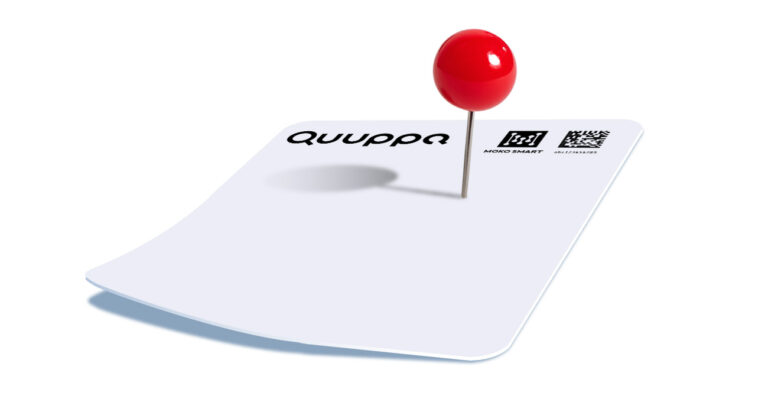
Through a technical collaboration with InPlay and MokoSmart, Quuppa is introducing a new class of device: the Precision Label Tag. By utilising the InPlay IN100 NanoBeacon™ SoC, we have successfully brought Quuppa’s Angle-of-Arrival (AoA) positioning into a form factor as thin and flexible as a standard shipping label.
This is the first time a disposable label-style tag has been tracked with sub-meter accuracy. It makes precise tracking practical for a class of items that has usually remained outside RTLS. We are no longer limited to tracking only the most expensive assets. A much broader share of the physical flow can now be brought into view.
Designed for high-volume flows
The Precision Label Tag is built for high-volume, fast-throughput environments. In these settings, the overhead of collecting and reattaching reusable tags is often too high. A disposable tag removes that burden.
Sustainability has also been a key consideration. The tag uses an eco-friendly, zinc-based paper battery. This makes it thin enough to conform to curved surfaces and light enough to be attached to almost any item without affecting the packaging or the process. Once the item reaches its destination, the tag has fulfilled its purpose.
From checkpoints to continuous visibility
Traditional checkpoint-based identification methods, like RFID, are useful for confirming that an item has passed a specific point in the process. What they do not provide is continuous visibility between those points. If an item is misplaced or a process stalls midway, the system cannot show its location.
Precision Label Tags provide continuous, real-time visibility across the facility. This enables more flexible processes without sacrificing control. Managers can detect bottlenecks earlier, optimise routes in real time, and see whether items are where they should be, with immediate alerts when they are not.
Instead of relying on occasional snapshots, operations gain a continuous stream of actionable data.
One infrastructure, broader visibility
Precision Label Tags operate on the existing Quuppa infrastructure. Premium tags for personnel and high-value assets can run on the same system as label tags used for high-volume items.
This means enterprises no longer have to choose between precision and scale: both can now exist on the same infrastructure.
- The trade-off between cost-efficiency and precision is over.
See the Precision Label Tag at LogiMAT
The world premiere of the Precision Label Tag will take place at LogiMAT in Stuttgart, 24–26 March. Visit Quuppa at stand 2C29 in Hall 2 to see sub-meter accurate label tracking in action and discuss how it could fit your operation.
If you are not attending LogiMAT, contact our sales team to learn more about upcoming commercial availability.

Frequently Asked Questions
Precision Label Tags use Quuppa’s Angle-of-Arrival technology to provide sub-meter positioning accuracy when used with Quuppa infrastructure.
The tag is activated by simply peeling it off the backing paper. Once removed, it automatically begins transmitting at the factory-set rate and continues to operate until the battery runs out.
The MokoSmart UT1 uses an environmentally friendly zinc-based paper battery and the ultra-low-power InPlay IN100 NanoBeacon™ SoC. Depending on the use case and configuration, battery life can range from days or weeks for real-time tracking of moving objects to several months for slower-moving or stationary items.
To reach the target price point and ultra-thin form factor, the tags are designed as programming-free devices. The transmit rate and power are factory-set and can be customised during manufacturing to match the customer’s application.
Yes. The label tags use a zinc-based paper battery and PVC-free materials, making them a sustainable option for high-volume disposable applications.