Access control that works without gates, badges, or bottlenecks
The Olympic Experience
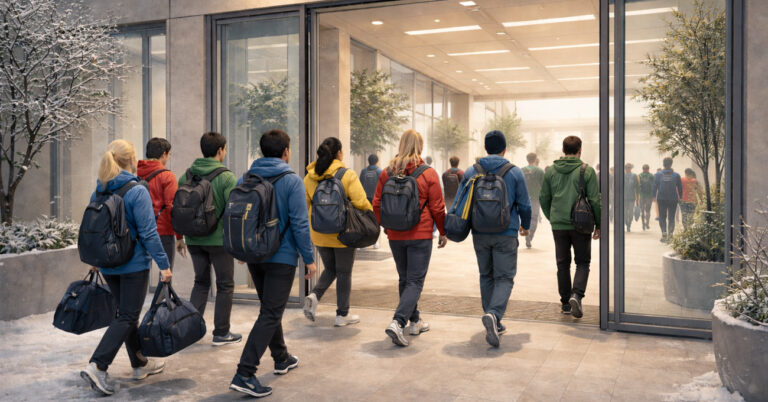
You arrive at the Olympic Village. The architecture is open and modern, defined by glass, light, and wide entrances. Some people move in larger groups. There are no visible checkpoints, no queues of people waiting to be processed, and no sense of being funnelled through security.
You walk towards the entrance with others, and the doors open. Your access was permitted without you noticing anything, which is exactly the intent.
Behind the scenes, access control is working continuously, but it is not experienced as control. There are no badges to show, no gates, no tags to collect, no physical tokens to remember. The system does not interrupt the flow of people.
The central challenge of this environment is to achieve these two seemingly contradictory goals simultaneously: World-class security for a global event, and an open, welcoming space where movement feels natural.
Crowd density is what makes this even more challenging. At peak moments, large groups of people arrive at the same time. This is where traditional access control systems struggle. Manual checks do not scale. Video can see people, but it cannot decide who is allowed to enter, and biometric identification is neither practical nor acceptable.
Yet access decisions still have to be made instantly, reliably, and without friction.
The invisible layer that makes access possible
The Milani Freeway access control system at the Olympic Village uses Quuppa’s real-time location data as an invisible decision layer.
Every authorised user carries a smartphone. As an alternative to distributing physical access tags, an application on the phone transmits a defined Bluetooth signal that emulates a tag. Quuppa’s Angle-of-Arrival technology locates these signals accurately and reliably in real time.
As groups approach an entrance, video and AI systems observe the number of people present and monitor for tailgating behaviour. Quuppa provides real-time confirmation of access permissions for each person. Milani’s Freeway Access Control logic compares these two realities. If the numbers and locations match, access is granted. If they do not, the system shows which individual is not allowed to enter, and security personnel will handle the situation.
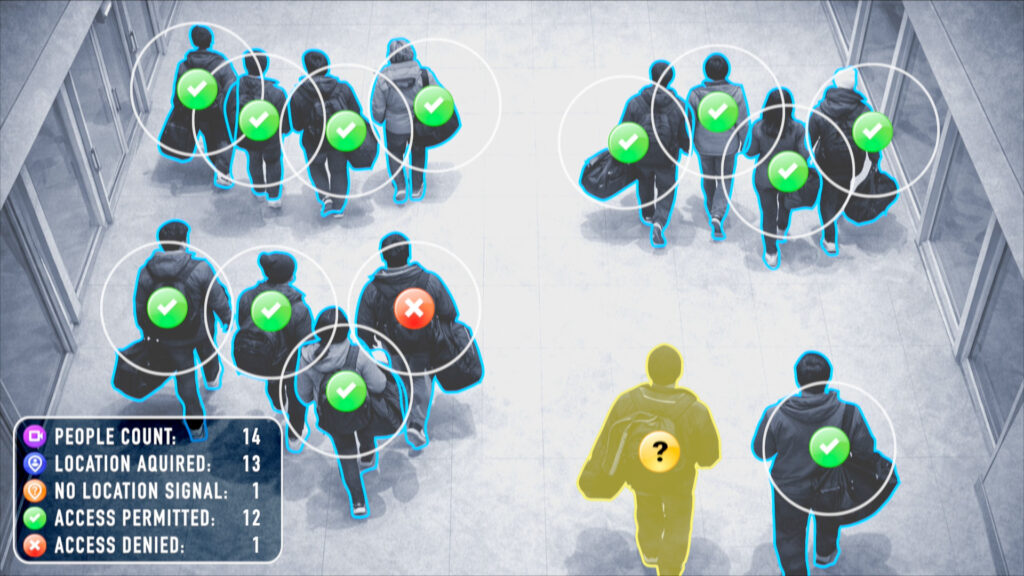
Without this location-based permission layer, video alone would only confirm that people are present. It would not be able to decide whether access should be allowed. In dense crowds, accurate location is used to determine who is allowed to enter. The flow of people is not interrupted; only the person without permission will be stopped. Security remains invisible, and the system intervenes only when necessary.
Privacy without compromise
The Freeway solution is designed to operate within strict privacy constraints. No biometric data is used. The system does not identify people; it validates access permissions in real time.
This approach makes it suitable for a high-profile international event where public trust, regulatory compliance, and operational reliability all matter equally.
After the Games
When the Olympic and Paralympic Games end, the Village does not disappear. It becomes student housing.
The context changes, but the need for reliable access control does not. The same buildings remain in use. The Freeway system remains in place. What changes is the rhythm of life.
Crowds are smaller and more predictable. Access patterns are everyday rather than exceptional: guest access, residential rules, and long-term continuity become more important than peak throughput. The access control logic adapts, but the foundation stays the same.
What was designed to function under the most extreme conditions now supports daily life. Security no longer has to scale for Olympic surges, but it still has to be trustworthy, unobtrusive, and easy to live with.
This continuity is key. Infrastructure built for a global event is not dismantled when the spotlight fades. It becomes part of the city and everyday life.
Access control as a data problem
Access control is often treated as a hardware problem: doors, locks, cameras, credentials. Fundamentally, it’s a data problem.
In environments where people move in groups and density fluctuates rapidly, systems need a reliable reality layer that reflects what is actually happening in the physical world.
The Milani Freeway solution shows how real-time location data can provide that layer. It enables access control that works under extreme crowd pressure and continues to function quietly in everyday environments.
The result is security that remains invisible when everything is normal, and decisive only when it is not.
Engineering invisible access at Olympic scale
Milani is an engineering and systems integrator with decades of experience delivering complex electrical, automation, and IoT solutions for large-scale, security-critical environments.
Freeway is Milani’s access control platform, designed to manage high-volume, barrier-free access while meeting strict requirements for reliability, cybersecurity, and GDPR compliance.
Quuppa provides the real-time location component within the Freeway system, supplying accurate location data that allows the platform to associate physical movement with digital access rights.
By combining video-based people counting with precise location data, Freeway enables access control decisions to be made in real time, without slowing people down and without relying on biometric identification.
The result is an access control system capable of operating at Olympic scale, and flexible enough to remain in use long after the Games are over.