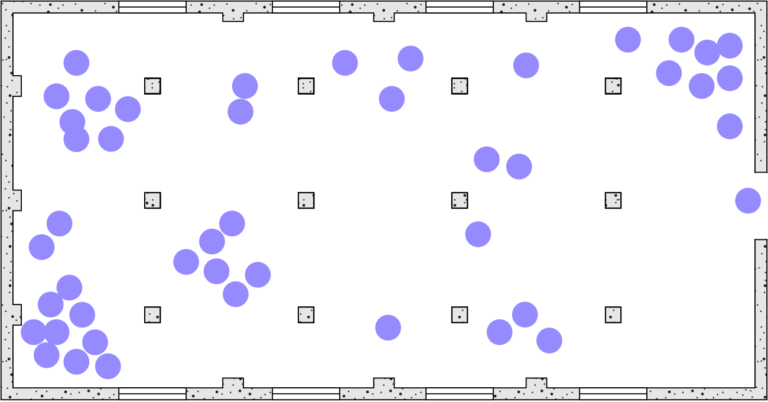
A dot on the map is the first goal for any Real-Time Locating System (RTLS). Seeing where assets or people are located confirms that the system works and that physical operations can be observed digitally. In many deployments, this is also where progress slows.
The issue is not data quality or quantity. Modern RTLS platforms produce accurate, high-frequency location updates with ease. The challenge arises when this data needs to support decisions, actions, or improvement in connected systems. Visibility alone does not create value unless it is translated into something operationally meaningful.
This is fundamentally an integration problem.
From location data to operational signals
Most downstream systems do not need continuous coordinates. They need signals that reflect changes in state:
- Asset entered or exited an area
- Movement stopped or resumed
- Process step was completed
- Exception occurred
These moments are when actions are taken or insights are formed.
When raw location data is forwarded without structure or intent, interpretation is pushed downstream into middleware or application logic. Over time, this leads to noisy data flows, fragile integrations, and systems that are difficult to scale.
The core challenge is aligning how data is produced with how operations actually function.
Event-driven integration as a design principle
Event-driven integration addresses this by focusing on change rather than constant updates. Instead of asking “where is everything now?”, systems react to “what just happened that matters?”.
Events, states, and transitions map naturally to operational logic. Designing integration around them reduces unnecessary data transfer and makes downstream behaviour more predictable. This is not a single feature, but a design principle that shapes how data leaves the system.
In the Quuppa Positioning Engine, this principle is implemented through mechanisms that allow relevance to be defined at the source.
Event-Driven Data Integration in the Quuppa Positioning Engine
At the centre of this approach is the concept of Output Targets. An Output Target defines a purpose-specific data stream by specifying
- What data is observed
- When output is triggered
- How data is packaged
- Where it is delivered
Multiple Output Targets can run in parallel, each serving a different use case. One may deliver immediate operational events, while another collects aggregated data for analysis or reporting. The same underlying location data supports both, without forcing them into a single integration pattern.
This allows integrations to be designed around actual needs rather than adapting every use case to a generic output.
Controlling when and what data is sent
The first dimension of control is timing. Output Targets support both interval-based and change-based triggering. Interval-based triggers provide regular snapshots when needed. Change-based triggers produce output only when something meaningful has changed.
By combining these, integrations can be designed to emit events instead of repeated updates, avoiding unnecessary processing in receiving systems.
The second dimension of control is content. Filtering allows Output Targets to be limited to specific conditions, such as zone changes, significant movement, or tag actions. Filtering is applied inside the Positioning Engine before data leaves the system.
This reduces data volume and moves integration logic closer to the source, where it can be applied consistently. Instead of duplicating filtering rules across multiple downstream systems, relevance is defined once and reused.
Controlling how data is delivered
Not all use cases require immediate delivery of individual events. For analytics and reporting, it is often more efficient to collect events over time and deliver them in batches.
Output Targets support configurable batching and send intervals, allowing integrators to balance timeliness and efficiency. Immediate events can be delivered as they occur, while other data can be aggregated and sent at predictable intervals. This reduces network traffic and lowers the load on receiving systems, especially in larger deployments.
The same integration model supports both real-time actions and deferred analysis through configuration, not additional tooling.
Designed to scale
In small deployments, ad-hoc integrations can be sufficient. As systems grow, poorly structured data flows become a limiting factor. Excessive data volumes, fragile middleware, and tightly coupled integrations all increase operational cost.
By providing fine-grained control over when, what, and how data is delivered, the Quuppa Positioning Engine enables integrations that remain manageable as deployments expand. Event-driven design reduces noise, filtering simplifies logic, and batching improves efficiency.
From dots to decisions
Seeing where things are is a necessary starting point for any location-based system. Turning that visibility into decisions is what creates lasting value.
Event-Driven Data Integration is how the Quuppa Positioning Engine supports this transition. By allowing relevance to be defined at the source and data flows to be tailored to specific use cases, the platform helps customers move beyond raw signals toward systems that are easier to operate, integrate, and scale.
What matters in the end is the outcome: location data structured to support decisions, not just display the dots on a map.
Solution looking for a problem?
Over the years, we’ve seen many RTLS deployments succeed technically but stall operationally. Most often, the reason is not the system itself, but that the right question was never asked, or never quite found. A classic case of a solution looking for a problem. Data looking for meaning.
We work with customers and partners to:
- clarify the operational questions that actually matter
- translate those questions into events, states, and signals
- configure the Quuppa Positioning Engine to deliver the right data, at the right time, in the right form
If you are exploring how to make better use of your location data, or want to sanity-check an existing setup, we’re happy to share our experience.

Further reading
If you want to go deeper into the technical details behind Event-Driven Data Integration in the Quuppa Positioning Engine, the following resources may be useful:
The Evolution of the Quuppa Positioning Engine API
A deep dive into how QPE data integration has evolved from raw data streams to event-driven outputs.
Product documentation: Output Targets, filtering, triggers, and batching
Practical guidance and configuration examples for designing event-driven data streams.