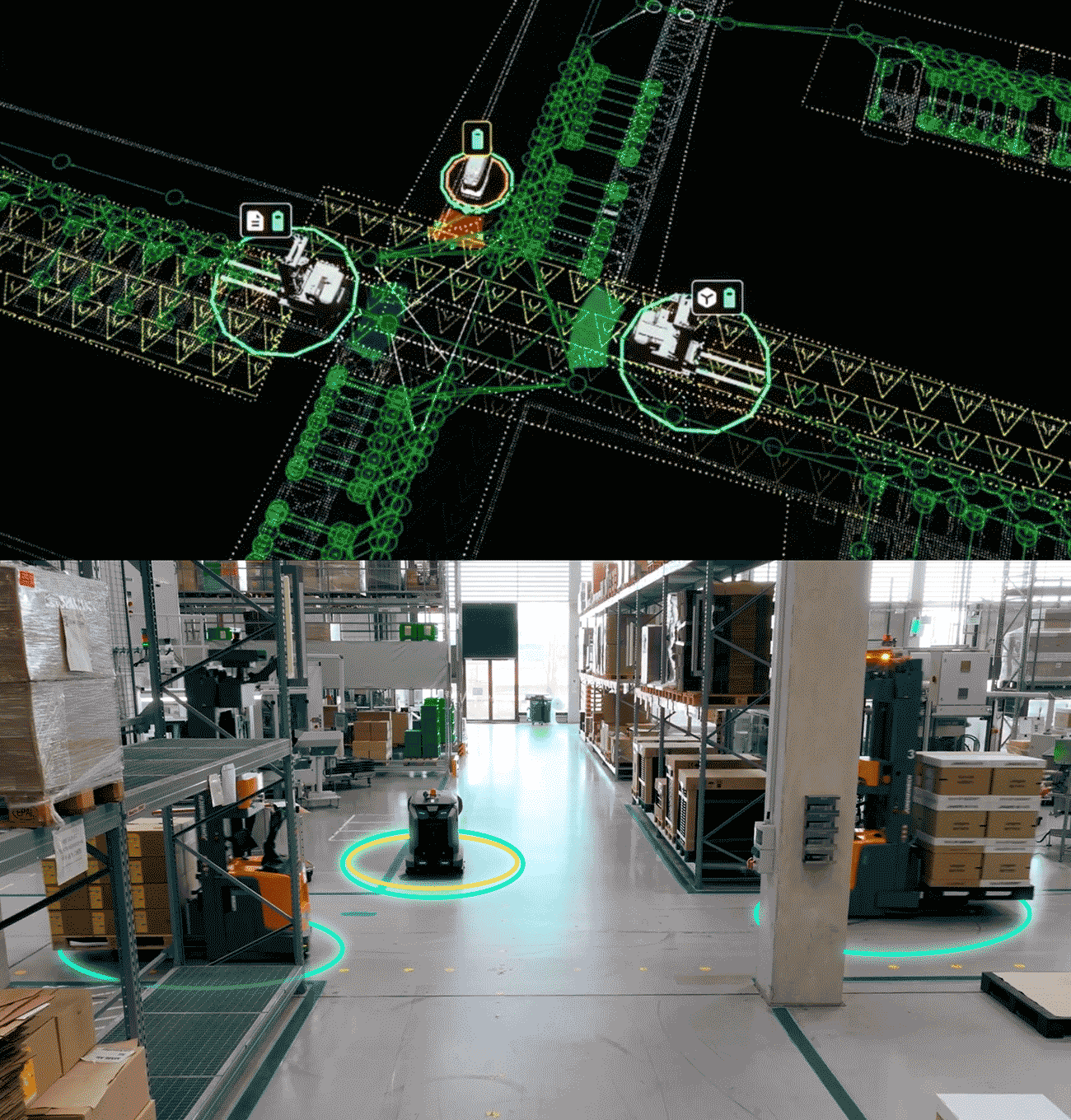
The industry is shifting from individual robots to integrated fleets.
In the modern warehouse, autonomous mobile robots (AMRs) are no longer a novelty. You have Jungheinrich forklifts moving pallets, Kärcher robots cleaning floors, and manual operators navigating the same aisles.
The challenge today isn’t the hardware—it’s the harmony. Most autonomous systems operate using onboard sensors to navigate their immediate surroundings. While they are brilliant at avoiding obstacles, they often lack a “birds-eye view” of the entire floor. For a truly efficient facility, different machines need to do more than just avoid each other; they need to understand each other.
The Seidel GmbH Case: A Symphony of Automation
At Seidel GmbH & Co. KG, the goal was a synchronised, multi-vendor fleet. They didn’t just want automation; they wanted a seamless material flow across hall boundaries.
To achieve this, Seidel implemented an ecosystem where brand boundaries disappear. The orchestration is handled by the NAiSE Traffic Management System, but for that system to work at its peak, it requires a unified, high-precision data stream. It needs to know exactly where every asset is, regardless of brand or type.
This is where Quuppa provides the “Reality Layer.”
The Universal Language of Location in action. See how Quuppa and NAiSE synchronise Jungheinrich and Kärcher fleets at Seidel GmbH.
Bridging the Data Gap
Quuppa acts as the Universal Language of Location. By providing high-precision, real-time location data across the entire facility, we provide the common ground that allows the NAiSE master control to coordinate the entire floor.
- The Shared Perspective: While robots use LiDAR for local safety, Quuppa provides the global coordinates. We help the system “see” around corners.
- The Interoperability: Because Quuppa is an open platform, it acts as a translator. It turns physical movement into digital data that the orchestration software uses to ensure forklifts and cleaning robots move in sync.
- The Efficiency: At Seidel, the Kärcher KIRA B 50 and Jungheinrich EKS 215a don’t just share space; they cooperate. If a forklift is approaching a high-traffic zone, the cleaning robot knows to adjust its path, ensuring the material flow never stops.
The Reality Check: Collaboration is the New Standard
The success at Seidel GmbH proves that the future of the “Smart Factory” isn’t found in a single machine, but in the collaboration between them.
By choosing an open, precise, and scalable location foundation like Quuppa, Seidel has built more than just an automated warehouse. They have created a transparent, predictable environment where data fuels performance. When every asset speaks the same language of location, true orchestration becomes possible.
Is your automation operating in a silo?
The most efficient fleets aren’t the ones with the most robots — they are the ones with the best data. If you are managing a multi-vendor environment and need to bridge the gap between “moving” and “orchestrating,” let’s discuss how the Universal Language of Location can synchronise your operations.